Submit a Review & Earn an Amazon Gift Card
You can now submit reviews for your favorite Tocris products. Your review will help other researchers decide on the best products for their research. Why not submit a review today?!
Submit Review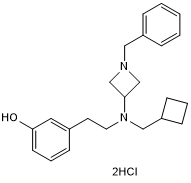
PIPE 3297 dihydrochloride is a potent and selective agonist of κ opioid receptor (KOR). It potently activates G-protein signaling (GTPγS EC50 = 1.1 nM, 91% Emax). It displays 40- and 600- fold selectivity over MOR and DOR respectively.
PIPE 3297 dihydrochloride induces differentiation of oligodendrocyte progenitor cells (OPC) in vitro and in vivo, leading to significant increase of mature oligodendrocytes (OL) in healthy mice and inducing myelination. It also reduces disease score in mouse experimental autoimmune encephalomyelitis (EAE) model. Exhibits low β-arrestin2 recruitment activity, avoding the sedating effects typically associated to other KOR agonists employed in demyelinating diseases.
PIPE 3297 dihydrochloride is brain penetrant and leads to 90% occupancy in CNS in vivo (mouse).
PIPE 3297 exhibits cardiotoxity with 72% hERG inhibition (3 μM) and unstability in liver microsomes.
| M. Wt | 423.42 |
| Formula | C23H30N2O.2HCl |
| Storage | Store at -20°C |
| Purity | ≥98% (HPLC) |
| PubChem ID | 170836120 |
| InChI Key | GLCDAGVRIMXVNE-UHFFFAOYSA-N |
| Smiles | OC1=CC=CC(CCN(CC2CCC2)C3CN(CC4=CC=CC=C4)C3)=C1.Cl.Cl |
The technical data provided above is for guidance only. For batch specific data refer to the Certificate of Analysis.
Tocris products are intended for laboratory research use only, unless stated otherwise.
| Solvent | Max Conc. mg/mL | Max Conc. mM | |
|---|---|---|---|
| Solubility | |||
| DMSO | 42.34 | 100 | |
| water | 8.47 | 20 |
The following data is based on the product molecular weight 423.42. Batch specific molecular weights may vary from batch to batch due to the degree of hydration, which will affect the solvent volumes required to prepare stock solutions.
| Concentration / Solvent Volume / Mass | 1 mg | 5 mg | 10 mg |
|---|---|---|---|
| 1 mM | 2.36 mL | 11.81 mL | 23.62 mL |
| 5 mM | 0.47 mL | 2.36 mL | 4.72 mL |
| 10 mM | 0.24 mL | 1.18 mL | 2.36 mL |
| 50 mM | 0.05 mL | 0.24 mL | 0.47 mL |
References are publications that support the biological activity of the product.
Schrader et al (2024) Identification and in vivo evaluation of myelination agent PIPE-3297, a selective kappa opioid receptor agonist devoid of β-Arrestin-2 recruitment efficacy. ACS Chem.Neurosci. 15 685 PMID: 38265210
If you know of a relevant reference for PIPE 3297 dihydrochloride, please let us know.
Keywords: PIPE 3297 dihydrochloride, PIPE 3297 dihydrochloride supplier, PIPE, 3297, potent, selective, kappa, κ, k, opioid, receptor, agonist, KOR, OPRK1, activator, G, protein, signaling, induces, activates, differentiation, oligodendrocyte, progenitor, cells, OPC, OLCNS, myelination, myelinating, agent, devoid, beta, B, β, arrestin, in, vivo, demy, HY-163277, CS-0998107, Kappa, Opioid, Receptors, Neural, Stem, Cells, 8135, Tocris Bioscience
Citations are publications that use Tocris products.
Currently there are no citations for PIPE 3297 dihydrochloride. Do you know of a great paper that uses PIPE 3297 dihydrochloride from Tocris? Please let us know.
There are currently no reviews for this product. Be the first to review PIPE 3297 dihydrochloride and earn rewards!
$25/€18/£15/$25CAN/¥75 Yuan/¥2500 Yen for a review with an image
$10/€7/£6/$10 CAD/¥70 Yuan/¥1110 Yen for a review without an image
Tocris offers the following scientific literature in this area to showcase our products. We invite you to request* your copy today!
*Please note that Tocris will only send literature to established scientific business / institute addresses.

Written by Sonia Tucci, Lynsay Kobelis and Tim Kirkham, this review provides a synopsis of the increasing number of peptides that have been implicated in appetite regulation and energy homeostasis; putative roles of the major peptides are outlined and compounds available from Tocris are listed.

The key feature of drug addiction is the inability to stop using a drug despite clear evidence of harm. This poster describes the brain circuits associated with addiction, and provides an overview of the main classes of addictive drugs and the neurotransmitter systems that they target.
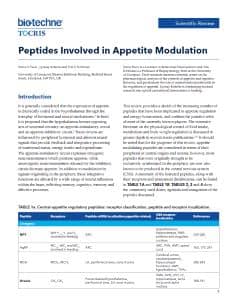
Our Peptides Involved in Appetite Modulation review gives an overview of the peptides implicated in appetite regulation and energy homeostasis.
Request copyRequest PDF
Written by Prof David Nutt, this poster summarizes the brain circuits and neurotransmitter systems that are affected by the main classes of addictive drugs.
Request copyDownload PDF
You can now submit reviews for your favorite Tocris products. Your review will help other researchers decide on the best products for their research. Why not submit a review today?!
Submit Review