Submit a Review & Earn an Amazon Gift Card
You can now submit reviews for your favorite Tocris products. Your review will help other researchers decide on the best products for their research. Why not submit a review today?!
Submit Review
β-Lipotropin 61-91 (or β-Endorphin) is an endogenous opioid peptide with potent antinociceptive activity, physiologically released in response to painful stimuli.
β-Lipotropin 61-91 can be used to study the expression of μ-opioid receptor in organ cultures and to investigate cardiovascular regulation.
In combination with 10 μM Prostaglandin E2 (Cat. No. 2296) and 1 μg/mL IGF-1, β-Lipotropin 61-91 (0.01 μM) constitutes the LIP cocktail, a small molecule mixture used to precondition human β-cells and primary islets, significantly enhancing function and survival when transplanted subcutaneously to female mice.
| M. Wt | 3465.03 |
| Formula | C158H251N39O46S |
| Sequence | YGGFMTSEKSQTPLVTLFKNAIIKNAYKKGE |
| Storage | Store at -20°C |
| Purity | ≥95% (HPLC) |
| CAS Number | 61214-51-5 |
| PubChem ID | 16132316 |
| InChI Key | JMHFFDIMOUKDCZ-NTXHZHDSSA-N |
| Smiles | O=C(NCC(NCC(N[C@@H](CC1=CC=CC=C1)C(N[C@@H](CCSC)C(N[C@@H]([C@H](O)C)C(N[C@@H](CO)C(N[C@@H](CCC(O)=O)C(N[C@@H](CCCCN)C(N[C@@H](CO)C(N[C@@H](CCC(N)=O)C(N[C@@H]([C@H](O)C)C(N2[C@@H](CCC2)C(N[C@@H](CC(C)C)C(N[C@@H](C(C)C)C(N[C@@H]([C@H](O)C)C(N[C@@H](CC(C)C)C(N[C@@H](CC3=CC=CC=C3)C(N[C@@H](CCCCN)C(N[C@@H](CC(N)=O)C(N[C@@H](C)C(N[C@@H]([C@@H](C)CC)C(N[C@@H]([C@@H](C)CC)C(N[C@@H](CCCCN)C(N[C@@H](CC(N)=O)C(N[C@@H](C)C(N[C@@H](CC4=CC=C(C=C4)O)C(N[C@@H](CCCCN)C(N[C@@H](CCCCN)C(NCC(N[C@@H](CCC(O)=O)C(O)=O)=O)=O)=O)=O)=O)=O)=O)=O)=O)=O)=O)=O)=O)=O)=O)=O)=O)=O)=O)=O)=O)=O)=O)=O)=O)=O)=O)=O)=O)[C@H](CC5=CC=C(C=C5)O)N |
The technical data provided above is for guidance only. For batch specific data refer to the Certificate of Analysis.
Tocris products are intended for laboratory research use only, unless stated otherwise.
| Solubility | Soluble to 1 mg/ml in 20% ethanol / water |
References are publications that support the biological activity of the product.
Vandana et al (2025) ChemPerturb-seq screen identifies a small molecule cocktail enhancing human beta cell survival after subcutaneous transplantation. CellStemCell 32 1 PMID: 40562034
Bloom et al (1976) Endorphins: profound behavioral effects in rats suggest new etiological factors in mental illness. Science 194 630 PMID: 185694
Hill et al (2002) The effects of beta-endorphin (beta-END) on cardiovascular and behavioral dynamics in conscious rats. Brain Res.Bull 59 29 PMID: 12372545
If you know of a relevant reference for β-Lipotropin 61-91, please let us know.
Keywords: b-Lipotropin 61-91, b-Lipotropin 61-91 supplier, β, beta, b, Lipotropin, 61-91, Endorphin, neuropeptide, endogenous, opioid, peptide, μ, receptor, cardiovascular, Prostaglandin, E2, PGE2, IGF-1, small, molecule, cocktail, LIP, enhances, enhancing, b-cells, β-cells, function, and, survival, subcutaneous, t, -Endorphin, Mu, Opioid, Receptors, Stem, Cell, Proliferation, 8984, Tocris Bioscience
Citations are publications that use Tocris products.
Currently there are no citations for β-Lipotropin 61-91. Do you know of a great paper that uses β-Lipotropin 61-91 from Tocris? Please let us know.
There are currently no reviews for this product. Be the first to review β-Lipotropin 61-91 and earn rewards!
$25/€18/£15/$25CAN/¥75 Yuan/¥2500 Yen for a review with an image
$10/€7/£6/$10 CAD/¥70 Yuan/¥1110 Yen for a review without an image
Tocris offers the following scientific literature in this area to showcase our products. We invite you to request* your copy today!
*Please note that Tocris will only send literature to established scientific business / institute addresses.

Written by Sonia Tucci, Lynsay Kobelis and Tim Kirkham, this review provides a synopsis of the increasing number of peptides that have been implicated in appetite regulation and energy homeostasis; putative roles of the major peptides are outlined and compounds available from Tocris are listed.

The key feature of drug addiction is the inability to stop using a drug despite clear evidence of harm. This poster describes the brain circuits associated with addiction, and provides an overview of the main classes of addictive drugs and the neurotransmitter systems that they target.

Our GMP stem cell compounds are suitable for use as ancillary reagents (raw materials) for the further manufacturing of stem cell therapies.
Learn More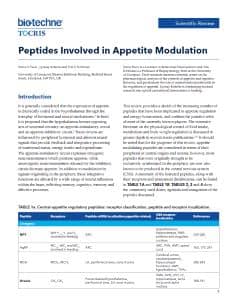
Our Peptides Involved in Appetite Modulation review gives an overview of the peptides implicated in appetite regulation and energy homeostasis.
Request copyRequest PDF
Written by Prof David Nutt, this poster summarizes the brain circuits and neurotransmitter systems that are affected by the main classes of addictive drugs.
Request copyDownload PDF
You can now submit reviews for your favorite Tocris products. Your review will help other researchers decide on the best products for their research. Why not submit a review today?!
Submit Review