Submit a Review & Earn an Amazon Gift Card
You can now submit reviews for your favorite Tocris products. Your review will help other researchers decide on the best products for their research. Why not submit a review today?!
Submit Review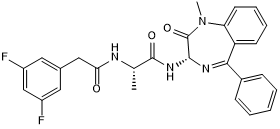
Compound E is a γ-secretase and notch pathway inhibitor. Compound E enhances growth inhibition, differentiation and migration of neuroblastoma cells when used in a combination with DAPT (Cat. No. 2634) and 13-cis RA. In combination with hLIF, CHIR 99021 (Cat. No. 4423) and SB 431542 (Cat. No. 1614), Compound E accelerates the induction of a homogeneous, self-renewing primitive neuroepithelium population from hESCs. Compound E is active in vitro and in vivo. Used in protocol to generate pancreatic beta cells from hPSCs (see below).
For more information about how Compound E may be used, see our protocol: Generation of β cells from hPSCs
This product is Bio-Techne's ancillary Material Grade version of Compound E (Cat. No. 6476). Suitable for use in research and further manufacturing of cell therapies. Find out more about our Ancillary Material Grade product range.
| M. Wt | 490.5 |
| Formula | C27H24F2N4O3 |
| Storage | Store at -20°C(±5°C) |
| Purity | ≥98% |
| CAS Number | 209986-17-4 |
| InChI Key | JNGZXGGOCLZBFB-IVCQMTBJSA-N |
| Smiles | C[C@@H](C(N[C@H]1N=C(C2=CC=CC=C2N(C1=O)C)C3=CC=CC=C3)=O)NC(CC4=CC(F)=CC(F)=C4)=O |
The technical data provided above is for guidance only. For batch specific data refer to the Certificate of Analysis.
Tocris products are intended for laboratory research use only, unless stated otherwise.
References are publications that support the biological activity of the product.
If you know of a relevant reference for Compound E, please let us know.
Keywords: Compound E, Compound E supplier, gamma-secretase, g-secretase, inhibitors, XXI, inhibits, secretases, neuronal, differentiation, neurons, self, renewal, notch, pathway, RMU, ancillary, grade, Gamma, Secretase, Inhibitor, Ancillary, Material, Grade, Small, Molecules, TB6476-RMU, Tocris Bioscience
Citations are publications that use Tocris products.
Currently there are no citations for Compound E. Do you know of a great paper that uses Compound E from Tocris? Please let us know.
There are currently no reviews for this product. Be the first to review Compound E and earn rewards!
$25/€18/£15/$25CAN/¥75 Yuan/¥2500 Yen for a review with an image
$10/€7/£6/$10 CAD/¥70 Yuan/¥1110 Yen for a review without an image
The following protocol features additional information for the use of Compound E (Cat. No. TB6476-RMU).
Tocris offers the following scientific literature in this area to showcase our products. We invite you to request* your copy today!
*Please note that Tocris will only send literature to established scientific business / institute addresses.

This product guide provides a background to the use of small molecules in stem cell research and lists over 200 products for use in:
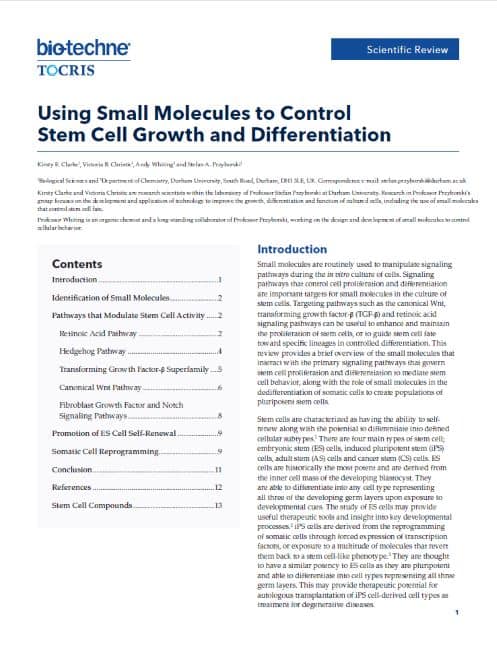
Written by Kirsty E. Clarke, Victoria B. Christie, Andy Whiting and Stefan A. Przyborski, this review provides an overview of the use of small molecules in the control of stem cell growth and differentiation. Key signaling pathways are highlighted, and the regulation of ES cell self-renewal and somatic cell reprogramming is discussed. Compounds available from Tocris are listed.

Stem cells have potential as a source of cells and tissues for research and treatment of disease. This poster summarizes some key protocols demonstrating the use of small molecules across the stem cell workflow, from reprogramming, through self-renewal, storage and differentiation to verification. Advantages of using small molecules are also highlighted.

Written by Rebecca Quelch and Stefan Przyborski from Durham University (UK), this poster describes the isolation of pluripotent stem cells, their maintenance in culture, differentiation, and the generation and potential uses of organoids.
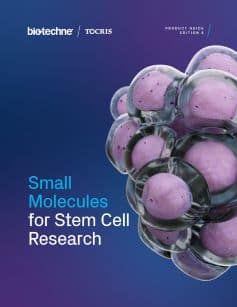
Our guide highlights the use of small molecules in stem cell research and cell therapy and lists relevant products.
Request copyRequest PDF
Our Stem Cells review gives an overview of the use of small molecules in the control of stem cell growth & differentiation and somatic cell reprogramming.
Request copyRequest PDF
Developed in-house, this poster summarizes how small molecules have been used in protocols across the stem cell workflow.
Request copyDownload PDF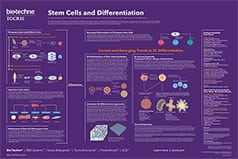
Written by Rebecca Quelch and Stefan Przyborski, this poster summarizes the isolation of pluripotent stem cells, their maintenance in culture, differentiation, and potential uses.
Download PDF
You can now submit reviews for your favorite Tocris products. Your review will help other researchers decide on the best products for their research. Why not submit a review today?!
Submit Review