Submit a Review & Earn an Amazon Gift Card
You can now submit reviews for your favorite Tocris products. Your review will help other researchers decide on the best products for their research. Why not submit a review today?!
Submit Review
S-Trityl-L-cysteine is a potent, cell-permeable, selective inhibitor of mitotic kinesin Eg5, a protein required for establishing and maintaining a bipolar spindle. Inhibits basal ATPase activity (IC50 = 1 mM) and microtubule-activated ATPase activity of Eg5 (IC50 = 140 nM). Induces mitotic arrest in HeLa cells with an IC50 of 700 nM. Displays antitumor activity.
| M. Wt | 363.47 |
| Formula | C22H21NO2S |
| Storage | Store at +4°C |
| CAS Number | 2799-07-7 |
| PubChem ID | 7271795 |
| InChI Key | DLMYFMLKORXJPO-HXUWFJFHSA-N |
| Smiles | N[C@@H](C(O)=O)CSC(C2=CC=CC=C2)(C3=CC=CC=C3)C1=CC=CC=C1 |
The technical data provided above is for guidance only. For batch specific data refer to the Certificate of Analysis.
Tocris products are intended for laboratory research use only, unless stated otherwise.
References are publications that support the biological activity of the product.
DeBonis et al (2004) In vitro screening for inhibitors of the human mitotic kinesin Eg5 with antimitotic and antitumour activities. Mol.Cancer Ther. 3 1079 PMID: 15367702
Brier et al (2004) Identification of the protein binding region of S-trityl-L-cysteine, a new potent inhibitor of mitotic kinesin Eg5. Biochemistry 43 13072 PMID: 15476401
Keywords: S-Trityl-L-cysteine, S-Trityl-L-cysteine supplier, Potent, selective, inhibitors, inhibits, mitotic, kinesin, Eg5, Mitotic, Kinesin, Mitosis, NSC83265, NSC, 83265, 2191, Tocris Bioscience
Citations are publications that use Tocris products. Selected citations for S-Trityl-L-cysteine include:
Müllers et al (2014) Nuclear translocation of Cyclin B1 marks the restriction point for terminal cell cycle exit in G2 phase. PLoS Genet 13 2733 PMID: 25486360
Hégarat et al (2014) PP2A/B55 and Fcp1 regulate Greatwall and Ensa dephosphorylation during mitotic exit. J Pharmacol Exp Ther 10 e1004004 PMID: 24391510
Hengeveld (2017) Inner centromere localization of the CPC maintains centromere cohesion and allows mitoticcheckpoint silencing. Nat Commun 8 15542 PMID: 28561035
Cilibrasi et al (2019) A Ploidy Increase Promotes Sensitivity of Glioma Stem Cells to Aurora Kinases Inhibition. J Oncol 2019 9014045 PMID: 31531022
Hindriksen et al (2017) Baculoviral delivery of CRISPR/Cas9 facilitates efficient genome editing in human cells. PLoS One 12 e0179514 PMID: 28640891
Ferreira et al (2018) Dissecting the role of the tubulin code in mitosis. Methods Cell Biol 144 33 PMID: 29804676
Average Rating: 4 (Based on 1 Review.)
$25/€18/£15/$25CAN/¥75 Yuan/¥2500 Yen for a review with an image
$10/€7/£6/$10 CAD/¥70 Yuan/¥1110 Yen for a review without an image
Filter by:
I used the product to synchronise the cells at mitotic entry.

Tocris offers the following scientific literature in this area to showcase our products. We invite you to request* your copy today!
*Please note that Tocris will only send literature to established scientific business / institute addresses.

This product guide provides a review of the cell cycle and DNA damage research area and lists over 150 products, including research tools for:
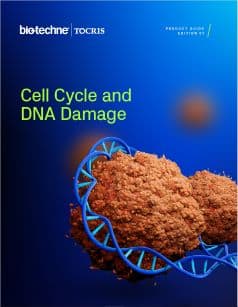
Our Cell Cycle and DNA Damage Research Guide highlights over 750 products for cell cycle and DNA damage research.
Request copyRequest PDF
You can now submit reviews for your favorite Tocris products. Your review will help other researchers decide on the best products for their research. Why not submit a review today?!
Submit Review