Submit a Review & Earn an Amazon Gift Card
You can now submit reviews for your favorite Tocris products. Your review will help other researchers decide on the best products for their research. Why not submit a review today?!
Submit Review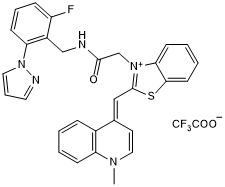
Key information: SALAD1 is a specific and high-affinity aptamer-ligand for aptamer Mango II (KDapp = 0.69 nM). Green fluorogenic dye displaying 3.5-fold brighter fluorescence than other Mango aptamer dyes such as TO1-biotin. Binds 7.5-fold more tightly to Mango II compared to TO dye. SALAD1 exhibits a binding preference to its target RNA (Mango II) over the other three Mango aptamers (7-, 20- and 16-fold tighter than Mango I, III and IV).
The improved brightness and tighter binding of SALAD1 to Mango aptamers allow detection and tracking of RNA with greater sensitivity and spatial resolution, facilitating studies of RNA localization, dynamics, and expression in live-cell and single-molecule imaging applications.
Used for: imaging RNA in live and fixed cells, even at low concentration.
Application: confocal cellular imaging.
Properties and Photophysical Data: excitation and emission maxima (λ) measured in Mango selection buffer are 511 nm and 540 nm, respectively; quantum yield QY = 0.722; extinction coefficient ε(complex) = 47,284 M-1cm-1; fluorescence enhancement FE = 1,500; fluorescence efficiency E = 2,170 nM-1; brightness = 34,139 M-1cm-1. SALAD1 is cell-permeable.

| Emission Color | Green |
|---|---|
| λabs | 511 nm |
| λem | 540 nm |
| Extinction Coefficient (ε) | 47,284 M-1cm-1 |
| Quantum Yield (φ) | 0.722 |
| Cell Permeable | Yes |
| Application | Confocal cellular imaging |
Use our spectra viewer to interactively plan your experiments, assessing multiplexing options. View the excitation and emission spectra for our fluorescent dye range and other commonly used dyes.
Spectral Viewer
| M. Wt | 635.64 |
| Formula | C30H25FN5OS.C2F3O2 |
| Storage | Store at -20°C |
| Purity | ≥95% (HPLC) |
| InChI Key | WDAIBHZPVVKNPB-UHFFFAOYSA-N |
| Smiles | CN1C=C/C(C2=C1C=CC=C2)=C\C3=[N+](C4=CC=CC=C4S3)CC(NCC5=C(N6C=CC=N6)C=CC=C5F)=O.O=C(C(F)(F)F)[O-] |
The technical data provided above is for guidance only. For batch specific data refer to the Certificate of Analysis.
Tocris products are intended for laboratory research use only, unless stated otherwise.
| Solvent | Max Conc. mg/mL | Max Conc. mM | |
|---|---|---|---|
| Solubility | |||
| DMSO | 6.36 | 10 |
The following data is based on the product molecular weight 635.64. Batch specific molecular weights may vary from batch to batch due to the degree of hydration, which will affect the solvent volumes required to prepare stock solutions.
| Concentration / Solvent Volume / Mass | 1 mg | 5 mg | 10 mg |
|---|---|---|---|
| 0.1 mM | 15.73 mL | 78.66 mL | 157.32 mL |
| 0.5 mM | 3.15 mL | 15.73 mL | 31.46 mL |
| 1 mM | 1.57 mL | 7.87 mL | 15.73 mL |
| 5 mM | 0.31 mL | 1.57 mL | 3.15 mL |
References are publications that support the biological activity of the product.
Yang et al (2025) Structure-informed design of an ultrabright RNA-activated fluorophore. Nat.Chem. 17 1188 PMID: 40437193
If you know of a relevant reference for SALAD1, please let us know.
Keywords: SALAD1, SALAD1 supplier, SALAD1, Mango, aptamer, ligand, green, fluorescent, fluorogenic, dye, binds, binding, complex, pair, RNA, imaging, bright, high, affinity, intensity, subnanomolar, TO1, biotin, confocal, cellular, microscopy, fixed, live, cells, cell, permeable, Aptamer-based, Imaging, Fluorescent, Probes, 8974, Tocris Bioscience
Citations are publications that use Tocris products.
Currently there are no citations for SALAD1. Do you know of a great paper that uses SALAD1 from Tocris? Please let us know.
There are currently no reviews for this product. Be the first to review SALAD1 and earn rewards!
$25/€18/£15/$25CAN/¥75 Yuan/¥2500 Yen for a review with an image
$10/€7/£6/$10 CAD/¥70 Yuan/¥1110 Yen for a review without an image
Tocris offers the following scientific literature in this area to showcase our products. We invite you to request* your copy today!
*Please note that Tocris will only send literature to established scientific business / institute addresses.

This product guide provides a background to the use of Fluorescent Dyes and Probes, as well as a comprehensive list of our:
Our guide highlights the use of Fluorescent Dyes and Probes in research and provides background information on various imaging techniques.
Request copyRequest PDF
You can now submit reviews for your favorite Tocris products. Your review will help other researchers decide on the best products for their research. Why not submit a review today?!
Submit Review