Submit a Review & Earn an Amazon Gift Card
You can now submit reviews for your favorite Tocris products. Your review will help other researchers decide on the best products for their research. Why not submit a review today?!
Submit Review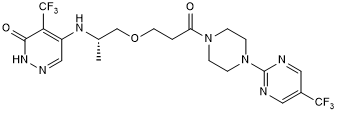
RBN-2397 is a potent and selective PARP7 inhibitor. RBN-2397 inhibits PARP7 with an IC50< 3 nM and KD = 0.22 nM in a probe displacement assay and IC50 = 1 nM in a NanoBRET assay. It displays >500-fold selectivity over PARP12 and >50-fold selectivity over all other PARPs.
RBN-2397 inhibits MARylation of multiple intracellular proteins in PARP7-overexpressing SK-MES-1 cells with an IC50 = 2 nM, showing a 300-fold window over the inhibition of PARylation in PARP1-activated HeLa cells. It restores the Type I interferon (IFN) response in tumor cells and induces antitumor immunity dependent on Type I IFN and CD8 cells. Significantly increases the number of cells in the G0/G1 phase of the cell cycle, indicative of a cell-cycle arrest.
RBN-2397 inhibits tumor growth at all dose levels and schedules in CT26 tumor-bearing, immunocompetent BALB/c mice. It slows tumor growth (TGI: 49-67%) in most xenograft models, with complete tumor regression in the NCI-H1373 xenograft.
RBN-2397 is orally bioavailable.
| M. Wt | 523.44 |
| Formula | C20H23F6N7O3 |
| Storage | Store at -20°C |
| Purity | ≥98% (HPLC) |
| CAS Number | 2381037-82-5 |
| PubChem ID | 146047148 |
| InChI Key | UQZCQKXJAXKZQH-LBPRGKRZSA-N |
| Smiles | FC(F)(C1=C(C=NNC1=O)N[C@@H](C)COCCC(N2CCN(C3=NC=C(C(F)(F)F)C=N3)CC2)=O)F |
The technical data provided above is for guidance only. For batch specific data refer to the Certificate of Analysis.
Tocris products are intended for laboratory research use only, unless stated otherwise.
| Solvent | Max Conc. mg/mL | Max Conc. mM | |
|---|---|---|---|
| Solubility | |||
| DMSO | 26.17 | 50 | |
| ethanol | 2.62 | 5 |
The following data is based on the product molecular weight 523.44. Batch specific molecular weights may vary from batch to batch due to the degree of hydration, which will affect the solvent volumes required to prepare stock solutions.
| Concentration / Solvent Volume / Mass | 1 mg | 5 mg | 10 mg |
|---|---|---|---|
| 0.5 mM | 3.82 mL | 19.1 mL | 38.21 mL |
| 2.5 mM | 0.76 mL | 3.82 mL | 7.64 mL |
| 5 mM | 0.38 mL | 1.91 mL | 3.82 mL |
| 25 mM | 0.08 mL | 0.38 mL | 0.76 mL |
References are publications that support the biological activity of the product.
Gozgit et al (2021) PARP7 negatively regulates the type I interferon response in cancer cells and its inhibition triggers antitumor immunity. Cancer Cell 39 1214 PMID: 34375612
Chen et al (2025) PARP7 inhibitors and AHR agonists act synergistically across a wide range of cancer models. Mol.Cancer.Ther 24 56 PMID: 39313957
Yang et al (2023) Induction of PARP7 creates a vulnerability for growth inhibition by RBN2397 in prostate cancer cells. Cancer Res.Comm. 3 592 PMID: 37077937
If you know of a relevant reference for RBN-2397, please let us know.
Keywords: RBN-2397, RBN-2397 supplier, RBN2397, potent, selective, inhibitor, inhibits, binds, PARP7, over, PARP12, cancer, immunotherapy, restores, Type, I, interferon, IFN, induces, antitumor, immunity, in, vivo, orally, bioavailable, oncology, metastatic, solid, tumors, Poly(ADP-ribose), Polymerase, 9003, Tocris Bioscience
Citations are publications that use Tocris products.
Currently there are no citations for RBN-2397. Do you know of a great paper that uses RBN-2397 from Tocris? Please let us know.
There are currently no reviews for this product. Be the first to review RBN-2397 and earn rewards!
$25/€18/£15/$25CAN/¥75 Yuan/¥2500 Yen for a review with an image
$10/€7/£6/$10 CAD/¥70 Yuan/¥1110 Yen for a review without an image
Tocris offers the following scientific literature in this area to showcase our products. We invite you to request* your copy today!
*Please note that Tocris will only send literature to established scientific business / institute addresses.

This product guide provides a review of the cell cycle and DNA damage research area and lists over 150 products, including research tools for:

In normal cells, each stage of the cell cycle is tightly regulated, however in cancer cells many genes and proteins that are involved in the regulation of the cell cycle are mutated or over expressed. This poster summarizes the stages of the cell cycle and DNA repair. It also highlights strategies for enhancing replicative stress in cancer cells to force mitotic catastrophe and cell death.

Our Cell Cycle and DNA Damage Research Guide highlights over 750 products for cell cycle and DNA damage research.
Request copyRequest PDF
Our Cell Cycle & DNA Damage Repair poster summarizes the stages of the cell cycle and DNA repair. It also highlights strategies for enhancing replicative stress in cancer cells to force mitotic catastrophe and cell death.
Request copyDownload PDF
You can now submit reviews for your favorite Tocris products. Your review will help other researchers decide on the best products for their research. Why not submit a review today?!
Submit Review