SEQURNA Smart-seq 2 Protocol
This is intended as a guide only.
In Brief Download the PDF of this protocol
SEQURNA is a synthetic thermostable RNase inhibitor for single-cell RNA-sequencing (scRNAseq), yielding single-cell libraries of equal or superior quality compared to ubiquitously used protein-based recombinant RNase inhibitors (RRIs).
SEQURNA provides additional unique improvements in reproducibility and throughput, enables new experimental workflows including retained RNase inhibition throughout heat cycles, and can reduce the need for dry-ice transports.
Important Information
- Using more RNase inhibitor than recommended does not improve results and may reduce cDNA library yield and quality.
- Different labs may use slight variations of the Smart-seq2 protocol, such as changes in lysis buffer detergent or concentration. Regardless of these modifications, use the recommended concentration of SEQURNA in the Smart-seq2 lysis buffer for all protocol versions.
Oligonucleotide Sequences (5’ to 3’)
SS2 oligo dT: 5’–AAGCAGTGGTATCAACGCAGAGTACT30VN-3’
SS2 TSO: 5’-AAGCAGTGGTATCAACGCAGAGTACATrGrG+G-3’
ISPCR: 5’-AAGCAGTGGTATCAACGCAGAGT-3’
1. Preparation of Lysis Plates
1.1 Prepare the lysis buffer mix according to Table 1. Optimal concentration range of SEQURNA in the Smart-seq2 protocol is between 1-2 mass units/µl in the lysis buffer, resulting in 0.45-0.9 mass units/µl in the RT reaction.
| Reagent | Conc. in lysis buffer | ml per reaction | 96-well plate (110 rxns) |
|---|---|---|---|
| 0.2% Triton X-100 | 0.08% | 1.9 | 209 |
| SEQURNA (50 mass units/µl) | 1.2 mass units/µl | 0.11 | 12 |
| dNTPs mix (10 mM) | 2.2 mM | 1 | 110 |
| SS2 oligo dT primer (10 µM) | 2.2 µM | 1 | 110 |
| Nuclease-free water | - | 0.49 | 53.9 |
| ERCC spike-ins (Optional) | - | - | - |
| Total | 4.5 µl | 495 µl |
Table 1. Reagent preparation for Smart-seq2 lysis buffer: Volumes for 96-well plate
1.2 Add 4.5 µl lysis buffer to each well of a 96-well plate, and centrifuge briefly to collect lysis buffer in the bottom of the wells.
2. Sample Collection
2.1 Sort single cells into 4.5 µl of lysis buffer in 96-well plates.
2.2 Seal the plate with appropriate cover seals (tolerating -80°C to +110°C) and centrifuge the finished sorted plate immediately after. Transfer the plate to a -80°C freezer if not processing the cells into cDNA libraries within one day (plates can be stored at ~4°C for up to one day). Prompt processing is beneficial for retained RNA integrity.
3. Cell Lysis
3.1 Remove the plate of sorted cells from the -80°C freezer and incubate in a thermocycler with heated lid at 72 °C for 3 min, followed by a 4 °C hold. Ensure that the plate is properly sealed, to avoid evaporation (use thermal pads, depending on thermocycler model).
4. Reverse Transcription
4.1 While the plate is incubating at the cell lysis step, prepare the reverse transcription master-mix as described in Table 2. Do not add additional inhibitor in the RT reaction. The SEQURNA from the lysis buffer stays effective throughout lysis and the following RT.
| Reagent | Reaction Conc. | ml per reaction | 96-well plate (110 rxns) |
|---|---|---|---|
| SuperScript II reverse transcriptase (200 units/μl) | 100 units | 0.5 | 55 |
| Superscript II First Strand buffer (5x) | 1× | 2 | 220 |
| DTT (100 mM) | 5 mM | 0.5 | 55 |
| Betaine (5 M) | 1 M | 2 | 220 |
| MgCl2 (1 M) | 10 mM | 0.1 | 11 |
| TSO (100 μM) | 1 μM | 0.1 | 11 |
| Nuclease-free water | - | 0.3 | 33 |
| Total | 5.5 µl | 605 µl |
Table 2. Reagent preparation for reverse transcription reaction: Volumes for 96-well plates
4.2 Add 5.5 µl RT mix to each well of a 96-well plate without dipping pipette tips into the lysis buffer, avoiding loss of original RNA molecules (no mixing needed).
4.3 Replace the storage seal with a fresh PCR seal. Ensure that the plate is properly sealed to avoid evaporation (use thermal pads, depending on thermocycler model).
4.4 Briefly centrifuge to collect reaction at the bottom of the tube.
4.5 Incubate the plate in a thermocycler at conditions listed in Table 3.
| Temperature | Time | Cycles |
|---|---|---|
| 42 °C | 90 min | 1× |
|
50 °C 42 °C |
2 min 2 min |
10× |
| 72 °C | 15 min | 1× |
| 4°C | Hold | Hold |
Table 3. Thermocycling conditions for reverse transcription
5. Pre-amplification PCR
5.1 Start preparing the PCR mix when the incubation of the reverse transcription reaction is near completion, by combining the reagents listed in Table 4.
| Reagent | Reaction conc. | µl per reaction | 96-well plate (110 rxns) |
|---|---|---|---|
| KAPA HiFi HotStart ReadyMix (2×) | 1× | 12.5 | 1375 |
| ISPCR primers (10 μM) | 0.08 μM | 0.2 | 22 |
| Nuclease-free water | – | 2.3 | 253 |
| Total volume | – | 15 µl | 1650 µl |
Table 4. Reagent preparation for PCR amplification: Volumes for 96-well plates
5.2 Add 15 µl PCR mix to each well of the 96-well plate without dipping pipette tips into the first-strand cDNA mix, avoiding loss of original unamplified cDNA molecules (no mixing needed).
5.3 Briefly centrifuge to collect reaction at the bottom of the plate. Seal with a new PCR seal. Ensure that the plate is properly sealed, to avoid evaporation (use thermal pads, depending on thermocycler model).
5.4 Incubate the plate in a thermocycler at conditions listed in Table 5.
| Step | Temperature | Time | Cycles |
|---|---|---|---|
| Initial denaturation | 98 °C | 3 min | 1× |
|
Denaturation Annealing Elongation |
98 °C 67 °C 72 °C |
20 s 15 s 6 min |
18-25×* |
| Final Elongation | 72 °C | 5 min | 1× |
| Hold | 4 °C | Hold |
* Depending on cell type (reflecting RNA content per cell)
6. cDNA Purification
6.1 To purify cDNA, add 0.8:1 ratio of beads to sample (20 µl) and mix by gently pipetting up and down. At this step, the PCR products can also be transferred to a round-bottom 96-plate for easier bead purification.
6.2 Incubate at room temperature for 8 min.
6.3 Place on magnet and allow beads to settle for ~5 min.
6.4 Discard the supernatant and wash with 100 μl of freshly prepared 80% ethanol, keeping the plate on the magnet.
6.5 Remove the ethanol and repeat step 6.4.
6.6 Remove all ethanol and let the beads air dry for 2-5 min (do not over-dry the pellets).
6.7 Elute cDNA by adding 18 µl UltraPure Water or other suitable elution buffer (e.g., 10 mM Tris-HCl, pH 8.5) onto the pellets. Do not remove the plate from the magnet before adding the elution solution, as the magnetic pellets may then “jump”.
6.8 Remove the plate from the magnet and resuspend beads by pipetting up and down. Incubate for 8 min.
6.9 Place on magnet until clear (~3 min) and collect the eluate, containing the purified cDNA, to fresh plates or tubes.
7. Quality Control
7.1 Inspect the cDNA library yield and size distribution of a few randomly selected samples by capillary electrophoresis, e.g., on an Agilent Bioanalyzer High Sensitivity DNA Analysis chip.
A representative Bioanalyzer image of successfully amplified Smart-seq2 cDNA from a HEK cell using SEQURNA is shown in Figure 1.
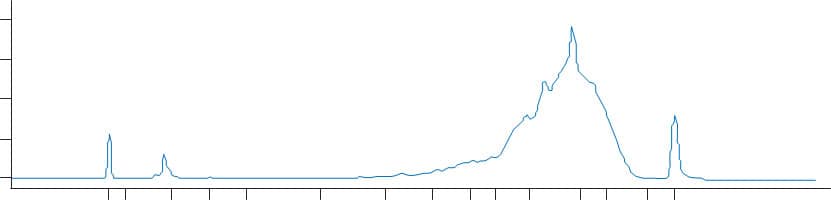
Figure 1. Trace of Smart-seq2 cDNA trace from a HEK cell, using an Agilent Bioanalyzer High Sensitivity DNA Analysis chip.
8. Additional Literature
For detailed instructions on preparing indexed sequencing libraries from Smart-seq2 cDNA using tagmentation and PCR, as well as the subsequent steps for library generation and indexing, refer to the original Smart-seq2 protocol:
- Picelli et al., (2014) Full-length RNA-seq from single cells using Smart-seq2. Nature Protocols 9 171.
For further details on the development of Smart-seq2:
- Picelli et al., (2013) Smart-seq2 for sensitive full-length transcriptome profiling in single cells. Nature Methods 10 1096.
For more information on SEQURNA:
- Noble et al. (2024) Introducing synthetic thermostable RNase inhibitors to single-cell RNA-seq. Nature Communications 15 8373