Cell Cycle
The cell cycle consists of a regulatory network of proteins that controls the order and timing of cellular proliferation events. It is divided into four stages, G1-S-G2-M. The G1 and G2 stages stands for 'GAP 1' and 'GAP 2' respectively. The S stage stands for 'Synthesis' and is the stage when DNA replication occurs. The M stage stands for 'mitosis', and is when nuclear and cytoplasmic division occurs, halving the genome.
Cell Cycle Target Files
Cell Cycle Regulation
There are three major regulatory cell cycle checkpoints - at the G1/S boundary, in the S-phase and during G2/M phases. A cell can only pass through these checkpoints in the presence of stimulatory signals and in the absence of DNA damage. If DNA damage cannot be repaired the cell is eliminated through apoptosis. Cyclin-dependent kinases (Cdks), along with cyclins, are major control switches at these checkpoints. They are central to cell cycle control; their activation via cyclin mediates progression through all four phases of the cell cycle.
p53 is a protein that functions to block the cell cycle if the DNA is damaged. If the damage is severe this protein can cause apoptosis. p53 levels are increased in damaged cells, blocking the cell cycle and allowing time for DNA repair to occur.
Cell Cycle and Cancer
Mutations in proteins controlling the cell cycle can lead to uncontrolled cell division, resulting in cancer - a disease where regulation of the cell cycle goes awry and normal cell growth and behavior is lost. A p53 mutation is the most frequent mutation leading to cancer. Understanding the processes and signaling pathways involved in the cell cycle has thus become the focus of intense interest in cancer research.
The Cell Cycle
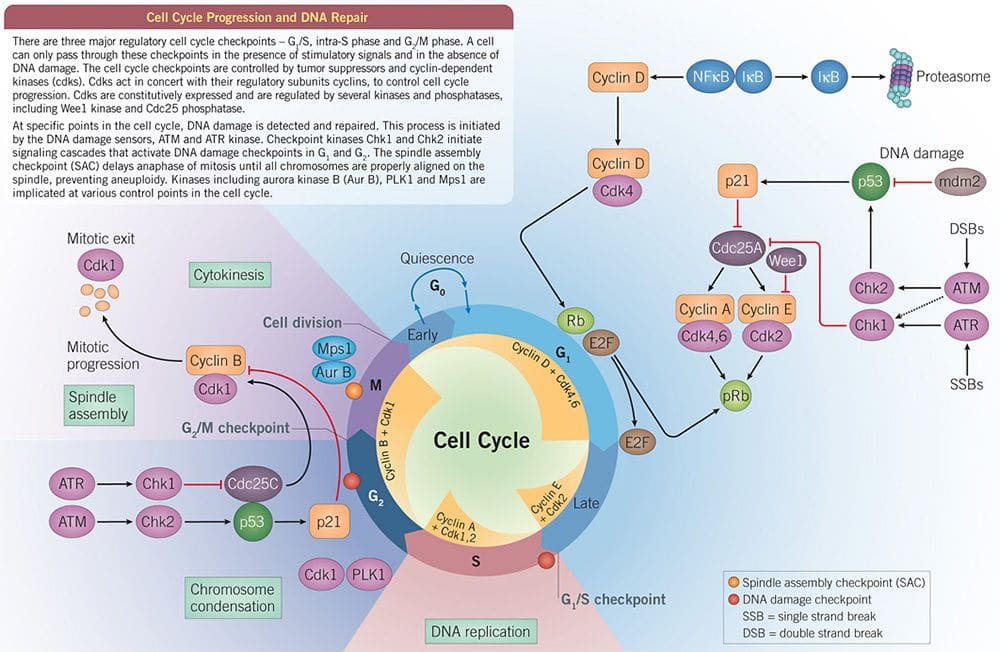
Figure 1: At specific points in the cell cycle, DNA damage is detected and repaired. The process is initiated by the DNA damage sensors, ATM and ATR kinase. Checkpoint kinases Chk1 and Chk2 initiate signaling cascades that activate DNA damage checkpoints in G1 and G2. The spindle assembly checkpoint (SAC) delays anaphase of mitosis until all chromosomes are properly aligned on the spindle, preventing aneuploidy. Kinases including aurora kinase B (Aur B), PLK1 and Mps1 are implicated at various control points in the cell cycle.
Literature for Cell Cycle
Tocris offers the following scientific literature for Cell Cycle to showcase our products. We invite you to request* your copy today!
*Please note that Tocris will only send literature to established scientific business / institute addresses.

Cell Cycle and DNA Damage Research Product Guide
This product guide provides a review of the cell cycle and DNA damage research area and lists over 150 products, including research tools for:
- Cell Cycle and Mitosis
- DNA Damage Repair
- Targeted Protein Degradation
- Ubiquitin Proteasome Pathway
- Chemotherapy Targets

Cell Cycle & DNA Damage Repair Poster
In normal cells, each stage of the cell cycle is tightly regulated, however in cancer cells many genes and proteins that are involved in the regulation of the cell cycle are mutated or over expressed. This poster summarizes the stages of the cell cycle and DNA repair. It also highlights strategies for enhancing replicative stress in cancer cells to force mitotic catastrophe and cell death.
Our Cell Cycle and DNA Damage Research Guide highlights over 750 products for cell cycle and DNA damage research.
Request copyRequest PDF
Our Cell Cycle & DNA Damage Repair poster summarizes the stages of the cell cycle and DNA repair. It also highlights strategies for enhancing replicative stress in cancer cells to force mitotic catastrophe and cell death.
Request copyDownload PDF