Orexin Receptors
The orexins (hypocretins) are a family of neuropeptides which play a role in regulating feeding and wakefulness. The family currently consists of two members; orexin A and orexin B (33- and 28-residues respectively), which are produced from a common precursor prepro-orexin (130 amino acids). Cell bodies of orexin-containing neurons are largely confined to the lateral hypothalamus, an area classically linked to feeding stimulation. Intracerebroventricular injections of orexin A and orexin B stimulate feeding in a dose-related manner, with orexin A being significantly more effective than orexin B. Orexins are also strongly linked to the regulation of sleep-activity cycles, which may restrict the use of orexin ligands in the treatment of obesity. The orexins activate two G-protein-coupled receptors (OX1 and OX2) also found predominantly in the hypothalamus. Orexin A is the selective endogenous agonist for OX1 and blocking this receptor modulates food and water intake.
To view Bio-Techne's complete solutions for lipid metabolism, glucose homeostasis, and energy balance, please visit our metabolism page on bio-techne.com
Literature for Orexin Receptors
Tocris offers the following scientific literature for Orexin Receptors to showcase our products. We invite you to request* your copy today!
*Please note that Tocris will only send literature to established scientific business / institute addresses.

Peptides Involved in Appetite Modulation Scientific Review
Written by Sonia Tucci, Lynsay Kobelis and Tim Kirkham, this review provides a synopsis of the increasing number of peptides that have been implicated in appetite regulation and energy homeostasis; putative roles of the major peptides are outlined and compounds available from Tocris are listed.
Orexin Receptor Data
| Receptor Subtype | OX1 Receptors | OX2 Receptors |
|---|---|---|
| G protein | Gq/11 | Gq/11 |
| Transduction Mechanism | ↑ PLC → ↑ Ca2+ influx | ↑ PLC → ↑ Ca2+ influx |
| Primary Locations | Ventromedial hypothalamus, locus coeruleus, median raphe, hippocampus, tenia tecta | Cerebral cortex (layers IV-VI), medial hypothalamus, paraventricular hypothalamus, nucleus accumbens, subthalamic and paraventricular thalamus, anterior pretectal nucleus |
| Likely Physiological Roles | Sleep-wakefulness, energy homeostasis | Sleep-wakefulness |
| Key Compounds | Ki Values (nM) | |
|---|---|---|
| Orexin A (human, rat, mouse) (1455) | 20 | 38 |
| Orexin B (human) (1456) | 420 | 36 |
| SB 334867 (1960) | 7.2* | < 5* |
| SB 408124 (1963) | 21.7† | 1405† |
| [Ala11,D-Leu15-Orexin B (2142) | 52‡ | 0.13‡ |
* pKb value, † Kb value, ‡ EC50 value
References
Smart et al (1999) Cahracterization of recombinant human orexin receptor pharmacology in a Chinese hamster ovary cell line using FLIPR. Br.J.Pharmacol. 128 1. Sutcliffe and de Lecea (2000) The hypocretins: excitatory neuromodulatory peptides for multiple homeostatic systems, including sleep and feeding. J.Neurosci. Res. 62 161. Smart (1999) Orexins: a new family of neuropeptides. Br.J.Anaesth. 83 695. Smart et al (2001) SB-334867-A: the first selective orexin-1 receptor antagonist. Br.J.Pharmacol. 132 1179. Asahi et al (2003) Development of an Orexin-2 receptor selective agonist [Ala11,D-Leu15orexin -B. Bioorg.Med.Chem.Letts. 13 111. Langmead et al (2004) Characterisation of the binding of [3H]-SB-674042, a novel nonpeptide antagonist, to the human orexin-1 receptor. Br.J.Pharmacol. 141 340.
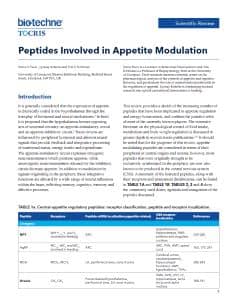
Our Peptides Involved in Appetite Modulation review gives an overview of the peptides implicated in appetite regulation and energy homeostasis.
Request copyRequest PDF