Submit a Review & Earn an Amazon Gift Card
You can now submit reviews for your favorite Tocris products. Your review will help other researchers decide on the best products for their research. Why not submit a review today?!
Submit Review
Noscapine hydrochloride is an opioid alkaloid with several actions. Binds to tubulin, arrests cells in mitosis and induces apoptosis. Antagonist at bradykinin receptors (pA2 = 6.68), inhibits carbachol-stimulated phosphoinositol turnover and enhances forskolin-stimulated cAMP increases in CNS tissues. Modulates IKK activation, suppressing the NF-κB signaling pathway. Blocks proliferation of human leukemia and multiple myeloma cells. Exhibits anti-inflammatory activity.
| M. Wt | 449.88 |
| Formula | C22H23NO7.HCl |
| Storage | Desiccate at RT |
| Purity | ≥99% (HPLC) |
| CAS Number | 912-60-7 |
| PubChem ID | 442329 |
| InChI Key | MFLVZFXCSKVCSH-URBRKQAFSA-N |
| Smiles | O=C2C1=C(OC)C(OC)=CC=C1[C@]([C@]3([H])N(CCC4=C3C(OC)=C5C(OCO5)=C4)C)([H])O2.Cl |
The technical data provided above is for guidance only. For batch specific data refer to the Certificate of Analysis.
Tocris products are intended for laboratory research use only, unless stated otherwise.
References are publications that support the biological activity of the product.
Landen et al (2002) Noscapine alters microtubule dynamics in living cells and inhibits the progression of melanoma. Cancer Res. 62 4109 PMID: 12124349
Mahmoudian and Mojaverian (2001) Effect of noscapine, the antitussive opioid alkaloid, on bradykinin-induced smooth muscle contraction in the isolated ileum of the guinea-pig. Acta Physiol.Hung. 88 231 PMID: 12162581
Mourey et al (1992) [3H]Noscapine binding sites in brain: relationship to indoleamines and the phosphoinositide and adenylyl cyclase messenger systems. Mol.Pharmacol. 42 619 PMID: 1331753
Sung et al (2010) Noscapine, a benzylisoquinoline alkaloid, sensitizes leukemic cells to chemotherapeutic agents and cytokines by modulating the NF-κB signaling pathway. Cancer Res. 70 3259 PMID: 20354190
Keywords: Noscapine hydrochloride, Noscapine hydrochloride supplier, Bradykinin, antagonists, tubulin, inhibitors, inhibits, induces, apoptosis, B1, B2, Receptors, Tau, Microtubules, Mitosis, antitumor, activity, HCl, opioid, alkaloid, 1697, Tocris Bioscience
Citations are publications that use Tocris products. Selected citations for Noscapine hydrochloride include:
Rennekamp et al (2016) σ1 receptor ligands control a switch between passive and active threat responses. Nat Chem Biol 12 552 PMID: 27239788
There are currently no reviews for this product. Be the first to review Noscapine hydrochloride and earn rewards!
$25/€18/£15/$25CAN/¥75 Yuan/¥2500 Yen for a review with an image
$10/€7/£6/$10 CAD/¥70 Yuan/¥1110 Yen for a review without an image
Tocris offers the following scientific literature in this area to showcase our products. We invite you to request* your copy today!
*Please note that Tocris will only send literature to established scientific business / institute addresses.

This product guide provides a review of the cell cycle and DNA damage research area and lists over 150 products, including research tools for:
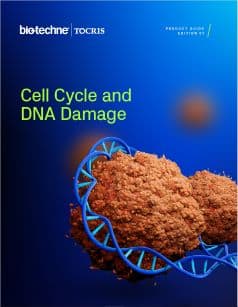
Our Cell Cycle and DNA Damage Research Guide highlights over 750 products for cell cycle and DNA damage research.
Request copyRequest PDF
You can now submit reviews for your favorite Tocris products. Your review will help other researchers decide on the best products for their research. Why not submit a review today?!
Submit Review