Opioid Receptors
Opioid receptors are currently classified into three groups, κ, δ and μ receptors. Subtypes within each group have been suggested including μ1, μ2, δ1, δ2, κ1, κ2, and κ3. An opioid-like receptor with a high degree of homology to μ, δ and κ-opioid receptors has been cloned and termed the orphan opioid receptor (NOP, ORL1). This receptor has a distinct pharmacological profile from the classical opioid receptors and an endogenous ligand, nociceptin (orphanin FQ) has been identified.
Literature for Opioid Receptors
Tocris offers the following scientific literature for Opioid Receptors to showcase our products. We invite you to request* your copy today!
*Please note that Tocris will only send literature to established scientific business / institute addresses.

Peptides Involved in Appetite Modulation Scientific Review
Written by Sonia Tucci, Lynsay Kobelis and Tim Kirkham, this review provides a synopsis of the increasing number of peptides that have been implicated in appetite regulation and energy homeostasis; putative roles of the major peptides are outlined and compounds available from Tocris are listed.

Addiction Poster
The key feature of drug addiction is the inability to stop using a drug despite clear evidence of harm. This poster describes the brain circuits associated with addiction, and provides an overview of the main classes of addictive drugs and the neurotransmitter systems that they target.
Opioid Receptor Data
| Receptor Subtype | μ (MOP, OP3) | δ (DOP, OP1) | κ (KOP, OP2) | NOP (ORL1, OP4) |
|---|---|---|---|---|
| G protein | Gi/o | Gi/o | Gi/o | Gi/o |
| Transduction Mechanism | Activation of inwardly rectifying K+ channels, inhibition of Ca2+ channels, inhibition of adenylyl cyclase | |||
| Localization in CNS | Anterior cingulate cortex, neocortex, amygdala, hippocampus, ventral dentate gyrus, presubiculum, nucleus accumbens, caudate putamen, thalamus, habenula, interpeduncular nucleus, pars compacta of the substantia nigra, superior and inferior colliculi, raphe nuclei | Medial habenula, hypothalamus, pons, medulla, dorsal root ganglion, caudate putamen, medial habenula, tegmentum, trigeminal nucleus | Claustrum, endopiriform nucleus, caudate putamen, nucleus accumbens, midline nuclear group of the thalamus, superficial grey layer of the superior colliculus, central grey, caudate putamen, nucleus accumbens, amygdala, thalamus, interpeduncular nuclei | Cortex, olfactory bulb, suprachiasmatic nucleus, amygdala, nucleus accumbens, thalamic nuclei, hypothalamus, hippocampus, septum, superior colliculus |
| Likely Physiological Roles | Respiration, cardiovascular functions, feeding, learning and memory, intestinal transit, locomotor activity, thermoregulation, hormone secretion, immune functions | Analgesia, motor integration, gastrointestinal motility, olfaction, respiration, cognitive function, mood driven behavior | Regulation of nociception, diuresis, feeding, neuroendocrine secretions | Motor and balance control, reinforcement and reward, nociception, the stress response, sexual behavior, aggression, autonomic control of physiological processes |
| Key Selective Agonists |
Endomorphin-1 (1055) Endomorphin-2 (1056) DAMGO (1171) |
SNC 80 (0764) SB 205607 (0921) DPDPE (1431) |
(±)-U-50488 (0495) BRL 52537 (0699) Dynorphin A (3195) |
Nociceptin (0910) MCOPPB (3763) SCH 221510 (3240) |
| Key Selective Antagonists |
β-Funaltrexamine (0926) CTOP (1578) Cyprodime (2601) |
Naltrindole (0740) Naltriben (0892) BNTX maleate (0899) |
nor-Binaltorphimine (0347) DIPPA (0794) GNTI (1282) |
UFP-101 (1552) (±)-J 113397 (2598) JTC 801 (2481) |
References
Dhawan et al (1996) International union of pharmacology. XII. Classification of Opioid Receptors. Pharmacol Rev. 48 567.
Cox et al (2009) Opioid receptors, introductory chapter. Last modified on 13/10/2009. Accessed on 27/02/2013. IUPHAR database (IUPHAR-DB).
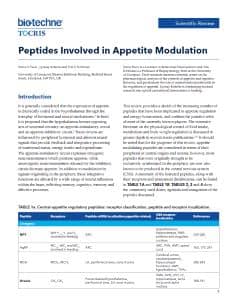
Our Peptides Involved in Appetite Modulation review gives an overview of the peptides implicated in appetite regulation and energy homeostasis.
Request copyRequest PDF
Written by Prof David Nutt, this poster summarizes the brain circuits and neurotransmitter systems that are affected by the main classes of addictive drugs.
Request copyDownload PDF